In recent years, twist museums—also called illusion museums, mirror museums, or twist art installations—have exploded in popularity. These venues allow visitors to step into immersive, mind-bending environments, where perspective, light, mirrors, and forced visual tricks combine to produce images that look surreal. Twist museum photos are the currency of modern social media: the more creative and bizarre your image, the more likely it is to go viral.
We present a comprehensive, detail-rich guide to twist museum photography. Whether you’re a professional photographer or a visitor with a smartphone, we will walk you through the best techniques, ideas, and tips to produce show-stopping images. We aim to outrank other sites by delivering value, actionable insight, and originality in every paragraph.
What Are Twist Museums & Why Their Photos Captivate
Twist museums are interactive art spaces that play on optical illusions, anamorphic art, forced perspective, mirror distortions, and rotated rooms. They challenge your visual assumptions. What appears upright from one angle becomes slanted or twisted from another. The effect is often disorienting, but it makes for compelling imagery.
The visual shock factor of twist museum photos is what compels people to share them. Audiences pause, stare, ponder: “How was that shot taken?” That intrigue is your entry ticket to social media reach. But behind the spectacle lies technical skill, planning, and creative intent.
Essential Gear & Settings for Twist Museum Photography
Smartphone or Pro Camera? Bring Both When You Can
Smartphone cameras now rival entry-level DSLRs in capability. The advantage of a smartphone is convenience—instant uploads, live previews, and intuitive composition. However, for fine control over depth of field and low-light performance, mirrorless or DSLR cameras remain superior. If you have both, bring them.
Lens Choice & Field of View
Wide-angle lenses (14mm to 24mm on full-frame or equivalent crop) are ideal for capturing entire illusion scenes. They exaggerate perspective, making the twist or distortion more dramatic. However, beware of excessive edge distortion—test before committing to a shot. For detail shots, a standard 35mm–50mm lens may suffice.
Camera Settings: Aperture, Shutter, ISO
-
Use a moderate aperture (f/5.6 to f/8) to maintain sharpness across the image, since many twist illusions rely on layers and depth.
-
For handheld shooting, ensure a fast enough shutter speed (at least 1/60 s or faster) to avoid motion blur.
-
Use ISO 400–800 in moderate indoor lighting; bump higher if necessary—just manage noise with good post-processing.
-
Turn off digital HDR or auto-merge modes, which might flatten the illusion’s contrast.
Focus & Metering
Manual or single-point autofocus is preferable. Choose the focal point carefully—if the illusion has a vanishing point or horizon, place focus there. Use spot metering to expose for your subject rather than the entire scene, which may include bright mirrors or lights that throw off exposure.
Planning Your Twist Museum Photo Session
Scout the Scene in Advance
Upon arrival, take a tour. Look for the most dramatic illusions, compelling lines, and vantage points. Note where walls bend, edges warp, or mirrors create infinite reflections. Make a mental map of promising spots.
Golden Hour vs Ambient Indoor Light
Because most twist museums are indoors, natural light is seldom present. Study existing lighting (spotlights, LED strips, ambient bulbs) and see how they affect color balance and shadow. Use those lines of light to guide composition and place your subject where illumination enhances the illusion.
Arrive Early or Off-Peak Times
These museums attract many visitors, especially on weekends and holidays. To get clear shots without crowd interference, visit early or on weekdays. Being first in line lets you frame shots before people stray into the scene.
Model & Prop Planning
If you’re photographing a person, decide poses that complement the twist. Leaning sideways, balancing on one foot, reaching out toward a mirror—these actions intensify the effect. Props like hats, umbrellas, or simple frames can help foreground your subject and anchor the illusion.
Composition & Posing Techniques for Twist Museum Photos
Use Leading Lines & Converging Perspective
Twist museums often include lines—rails, edges, corners—that converge toward a focal point. Use these to lead viewers’ eyes directly to your subject. Frame with symmetry when possible; symmetry heightens the visual tension in a distorted space.
Tilted Angles & Forced Perspective
Don’t hesitate to rotate your camera 15° to 30° to exaggerate the twist. Sometimes a slanted frame—even if the room is level—enhances disorientation. Forced perspective (placing your subject closer to the camera so they appear huge or small relative to the background) can amplify surrealism.
Reflections & Mirror Trickery
Mirrors offer doubling, infinite tunnels, or frame-inside-frame effects. Position your subject to interact with the mirror—touching, leaning, peeking behind it. Be cautious of your own reflection and the photographer’s presence; hide behind pillars or step aside and zoom.
Foreground-Background Dialogue
Place elements in foreground (props, patterns, textures) that echo or contrast with background illusions. This layering deepens the visual complexity and draws viewers in.
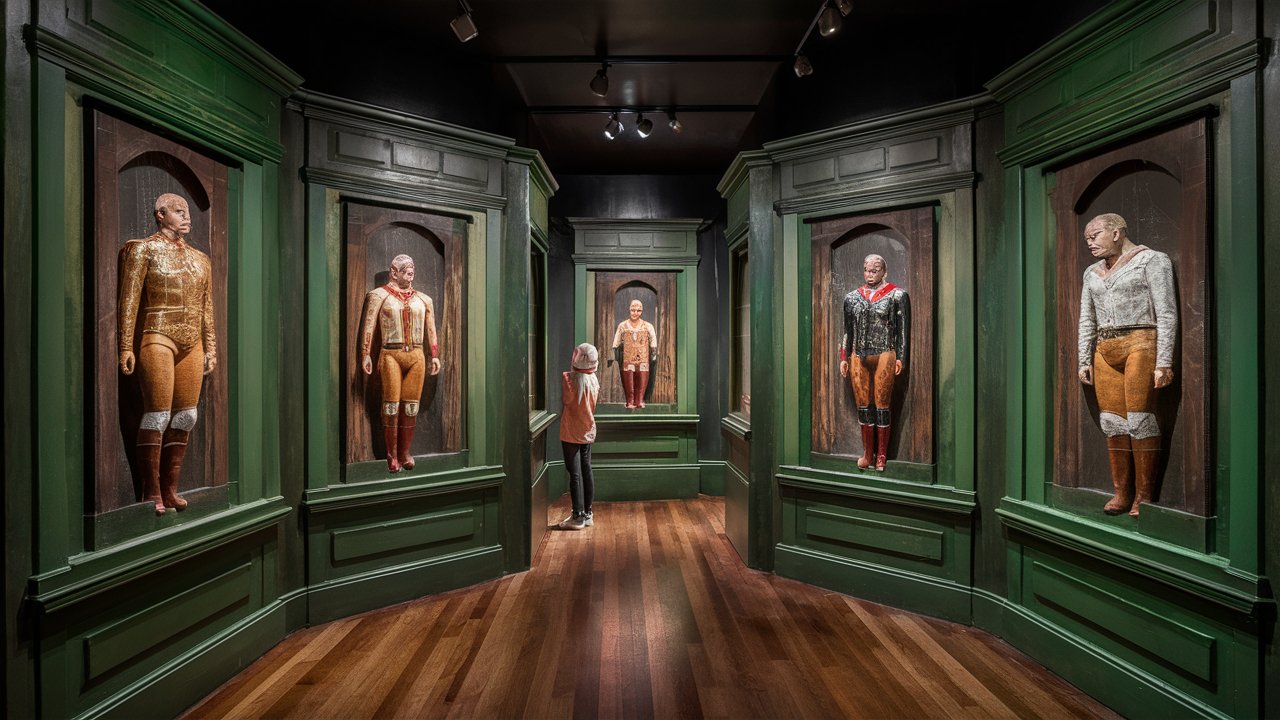
Editing & Post-Processing Tips for Twist Museum Photos
Color Grading & Contrast Enhancement
Amplify contrast to emphasize light vs shadow. Use subtle color grading (cool tones in shadows, warm tones in highlights) to maintain realism while elevating drama.
Perspective Correction (Use Judiciously)
Some distortion is intentional, but minor unevenness (tilted lines, trapezoidal warps) can be corrected with perspective tools. Use lens correction filters to straighten lines, but avoid overcorrecting—the twist must remain believable yet bizarre.
Dodging, Burning & Local Adjustments
Use dodging (lightening) and burning (darkening) to direct attention. Illuminate your subject’s face subtly if shadows are strong. Darken distracting areas or edges to prevent visual escape. Use vignette sparingly—just enough to anchor focus.
Remove Unwanted Artifacts
Clean up distracting reflections or stray objects (trash, signs) using healing brushes or content-aware fill. But don’t overdo it—natural flaws can sometimes deepen realism.
Top Twist Museum Destinations & Their Unique Visual Styles
-
Museum of Illusions (Various Cities) — Mirror mazes, rotating rooms, infinite reflections.
-
WonderWorks (Orlando, USA) — Upside-down rooms, topsy-turvy interiors.
-
Trick Eye Museum (Seoul, New York, etc.) — 3D painting illusions and floor-wall blending.
-
Museum of Twisted Light (Concept & pop-up installations) — Custom light sculpture illusions.
Each location offers a unique visual vocabulary—some lean heavy into mirrors, others into painted illusions or kinetic installations. Research which ones exist in your city or nearby travel destinations.
Creative Ideas & Challenges to Try
-
Mirror tunnel infinite loop: Position your subject at the center of parallel mirrors to create endless reflections.
-
Floor-turns-into-wall illusions: Pose so it looks like you’re climbing a wall or walking on a turned floor.
-
Half-silhouettes in split mirrors: One half of the mirror shows normal, the other a flipped version.
-
Color splash effect: Keep your subject in vivid color, set the rest to black-and-white to heighten focus.
-
Levitation illusions: Jump or hover (with post-sky removal) to give the impression of floating in the twisted space.
How to Leverage Twist Museum Photos for SEO & Social Impact
Because twist museum images generate intrigue, they’re ideal for shareable content—blog posts, Instagram carousels, Pinterest boards. When publishing:
-
Use descriptive filenames like.
-
Write alt text: “woman balancing sideways in twist museum photos.”
-
Embed in a blog post with contextual narrative: “how we captured this illusion.”
-
Encourage social shares by offering behind-the-scenes angles, before/after shots, or reveal videos.
Rich media plus insightful captions equals content that appeals to both search engines and humans.
Conclusion
Twist museum photos are a fusion of artistic illusion and photographic skill. By combining thoughtful planning, inventive composition, and precise post-processing, we can produce images that astonish viewers and dominate social media feeds. The key is exploring the scene, committing to bold angles, and refining your creative vision through editing.
Capture not just a twisted room—but a moment of cognitive dissonance that draws viewers in, makes them question reality, and compels them to share. The world of illusion photography rewards daring creativity.
FAQ — Twist Museum Photos
Q: What camera is best for twist museum photography?
A: A wide-angle capable mirrorless or DSLR is ideal, but modern smartphones also perform excellently. Bring both if possible.
Q: How to avoid reflections of the photographer in mirrors?
A: Approach corners or use off-axis viewpoints so your reflection is hidden. Use a remote trigger or hide behind props.
Q: Can I take photos with flash?
A: Flash often flattens the illusion. Rely on ambient light. If necessary, use an off-camera light with modifiers or bounce diffusion.
Q: How do I post-process without losing the illusion’s integrity?
A: Apply contrast, dodge/burn, perspective correction minimally, and remove distractions. Avoid heavy warping or excessive filters.
Q: Are twist museum photos copyrightable?
A: Yes — you own the copyright to your unique images. But always respect museum rules, signage, and posted photography policies.