Nestled in the idyllic English countryside near Arley, Cheshire, Arley Hall stands as a remarkable example of heritage, architectural elegance, and horticultural achievement. The estate uniquely blends deep history, lush formal gardens, and modern visitor experiences. In this comprehensive article, we explore the history, architecture, gardens, public access and visitor tips, and cultural significance of Arley Hall, aiming to provide a definitive reference that outshines current online coverage.
History of Arley Hall & Estate
The story of Arley Hall stretches back many centuries. The land around Arley has belonged to the Warburton family from at least the late 12th century. The first house on the site was built by Piers Warburton in 1469, who moved the family seat to Arley, constructing a moated, timber-framed structure. Over time, the house evolved: by the 18th century, Sir Peter Warburton encased the timber structure in brick and stucco, giving it a neoclassical exterior.
In 1832, a major rebuilding began under the direction of Rowland Egerton-Warburton, who commissioned architect George Latham to produce a new hall in the “Queen Elizabethan” or Jacobethan style. The new house was built between 1832 and 1845, carefully integrating stylistic echoes of Elizabethan and Jacobean architecture. A private Gothic Revival chapel, St Mary’s Chapel, designed by Anthony Salvin, was consecrated in 1845 adjacent to the hall.
Through the 20th century, parts of the hall fell into disrepair. Portions of the south front and ancillary wings were removed in 1968 to reduce maintenance, with careful replacement in 1987 by five private houses built in sympathetic style. Despite this, the core of the hall, the chapel, and the gardens remain under the ownership of Viscount Ashbrook and his family, open at selected times to the public.
Architectural Features & Interior Highlights
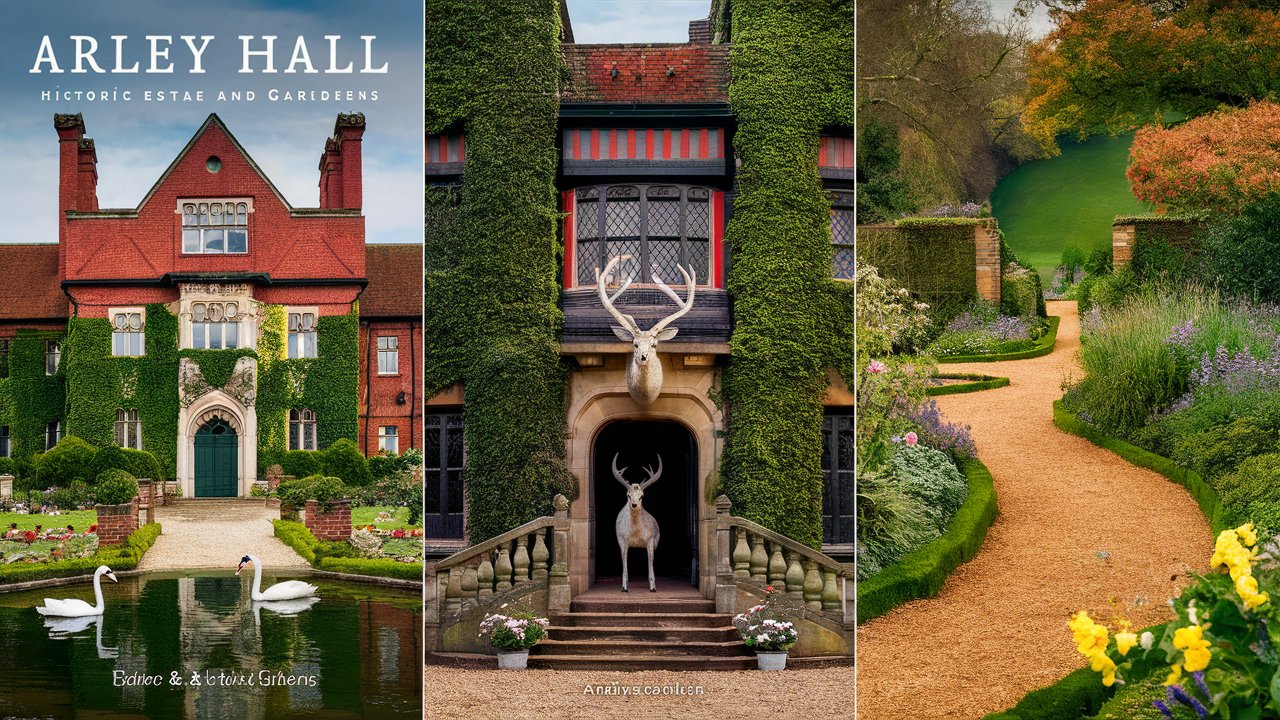
Arley Hall is built in brick with blue diaper patterning, stone dressings, mullioned windows, and Tudor-style chimneys, all resting under slate roofs. Its design is “Jacobethan,” a revivalist blend of Elizabethan and Jacobean elements, popular in the 19th century.
Exterior features
-
The south front is symmetrical with seven bays, and projecting end bays with canted windows and a parapet.
-
A clock tower frames part of the entrance drive, with a single-handed clock.
-
Adjacent to the hall, the Gothic Revival Chapel of St Mary is built of red sandstone and rendered brick, with a slate roof, lancet windows, bell turret, and stained glass by Kempe (1895).
-
The estate also contains listed ancillary buildings such as the cruck barn (Grade I), Tudor Barns, gate piers, walls, and other structures within the grounds.
Interior Highlights
Many rooms retain finely detailed wood panelling, ornate plaster ceilings, oak staircases, fireplaces, and original artworks. The Grand Staircase, carved in oak with plaster strapwork decoration, is considered one of Latham’s masterpieces. The Library has elaborate ceilings and stained glass windows from Paris, while drawing rooms and dining rooms combine period styles with family portraits. Upper rooms include the Emperor’s Room (where Prince Louis Napoleon stayed), the General’s Room, and an Exhibition Room telling the hall’s history.
Gardens & Landscape: The Horticultural Masterpiece
The gardens are among the finest in Britain, blending formal layout, creative planting, and landscapes allowing for personal exploration. The gardens are listed Grade II* in the National Register of Historic Parks and Gardens.
Garden Layout & Major Components
-
The Avenue of pleached lime trees welcomes visitors along a dignified approach.
-
The Double Herbaceous Border to the north of the Furlong Drive is celebrated as the first of its kind in England.
-
The Ilex Avenue features paired holm oaks clipped into cylindrical forms, bordering the path to the Sundial Circle.
-
The Rootree (formerly an alpine garden) leads to the Fish Garden, sunken pond, and Walled Garden, which includes a central pond with heraldic beasts statues and a modern flower sculpture.
-
The Kitchen Garden, Herb Garden, and Scented Garden lie to the east, featuring vegetables, herbs, seasonal planting, and scented shrubs.
-
To the northwest, the Grove and Woodland Walk offer a more informal and naturalistic experience, planted over recent decades by the Viscount to include rhododendrons, azaleas, and exotic shrubs.
The gardens combine strong formal axes with softer planted zones, making it an ideal place for year-round botanical interest and seasonal change.
Gardens in Public Life
Since the 1960s, the gardens have been opened to the public, and over time have become one of the top fifty gardens in Europe for plant enthusiasts. The plant nursery on the estate offers a selection of interesting perennials, shrubs, and climbers, many propagated on site.
Visiting Arley Hall: Practical Information & Tips
Opening Times & Admission
The gardens are open daily, generally from 10:00 am to 5:00 pm (with seasonal variations). The hall itself is open only on selected weekends or special open days — visitors must check the “What’s On” calendar before planning a visit. Admission fees vary by season and whether one visits just gardens or adds the hall.
How to Get There & Location
Arley Hall lies roughly 4 miles south of Lymm and 5 miles north of Northwich, in Cheshire, England. The postcode CW9 6NA is recommended for navigation, though signage from M6 and M56 junctions points travelers to the estate.
On-Site Facilities & Visitor Experience
Visitors can enjoy:
-
A café (Gardener’s Kitchen) and gift shop included with garden admission.
-
A plant nursery offers plants for purchase.
-
Children’s PlayZone with swings, zip wire, sandpit, willow domes, and open lawn for family time.
-
Picnic areas, wheelchair access on many garden paths, and dog-friendly policies (on short leads) — though dogs are not allowed in the hall or play zone.
-
The hall and grounds are frequently used for weddings, corporate events, and location filming.
Tips to Maximize Your Visit
-
Check the hall opening schedule before arrival: many interior rooms are only open intermittently.
-
Allow time for strolling through both formal gardens and woodland walks — a full garden tour can easily take two hours or more.
-
Bring comfortable shoes: some paths are uneven or cobbled.
-
Photography restrictions may apply in the hall interiors; outside photography is generally allowed.
-
For film buffs, note that Arley Hall doubled as “Arrow House” in Peaky Blinders.
-
Arrive early in the day to enjoy quieter garden ambiance before larger crowds.
Cultural & Media Significance
Arley Hall’s striking architecture and lush gardens have made it a favored filming location. Notably, it has appeared in Peaky Blinders, where it served as the elaborate home of Tommy Shelby, Arrow House in the series. Other film and television works, including The Forsyte Saga, Cluedo, Coronation Street, and Hollyoaks, have used Arley as a backdrop. This visibility has made Arley a point of interest not only for garden lovers but for fans of film and television seeking to step inside real-world settings of their favorite stories.
In visitor reviews, many commentators mention the “warm, intimate feeling” that Arley offers — the sense of a family home rather than a museum piece. Despite occasional critiques of café service or admission cost, the gardens themselves consistently receive high praise for their vitality, variety, and historic layering.
Conclusion
Arley Hall is so much more than an elegant Victorian country house: it is a living legacy of architecture, gardening artistry, and storytelling across centuries. From the refined Jacobethan facades and stained glass chapel to the lush double herbaceous borders, Ilex avenues, and sweeping woodland walks, the estate offers richness in both visual and experiential terms. As a heritage destination, public garden, and filming location, it occupies a unique niche in English cultural life.
Visiting Arley allows one to walk through living history, to wander garden rooms shaped by decades of plant design, and to sense the continuity of stewardship by one family over generations. For garden lovers, history enthusiasts, or fans of cinematic landscapes, Arley Hall stands as a must-see destination in Cheshire and beyond.
FAQ (Frequently Asked Questions)
Q: When is the hall open to visitors?
A: While the gardens at Arley Hall are open daily (typically 10 am to 5 pm, with adjusted last entry times), the hall interior opens only on selected weekends or special event days. Check the official calendar or “What’s On” page before your visit.
Q: What is the best time of year to visit the gardens?
A: Late spring through early autumn (May to September) is ideal for peak floral displays, especially in the double herbaceous border, rose gardens, and woodland walk. However, the gardens retain interest year-round with structural planting and evergreen features.
Q: Is photography allowed inside the hall?
A: Photography is usually allowed in the grounds and gardens, but certain interior spaces may have restrictions. Visitors are advised to confirm with staff on the day.
Q: Are weddings and events held at Arley Hall?
A: Yes. Arley Hall and its grounds are licensed for civil weddings and frequently host private and corporate events, given their atmospheric and picturesque spaces.
Q: How much time should I plan for a visit?
A: For a leisurely experience exploring gardens, woodland walks, nursery, café, and possibly a hall tour, allocate 2 to 3 hours (or more if attending a special event).